KaDeck
Versatile air conditioning for existing and new-build offices.
- Heating
- Cooling
- Ventilation
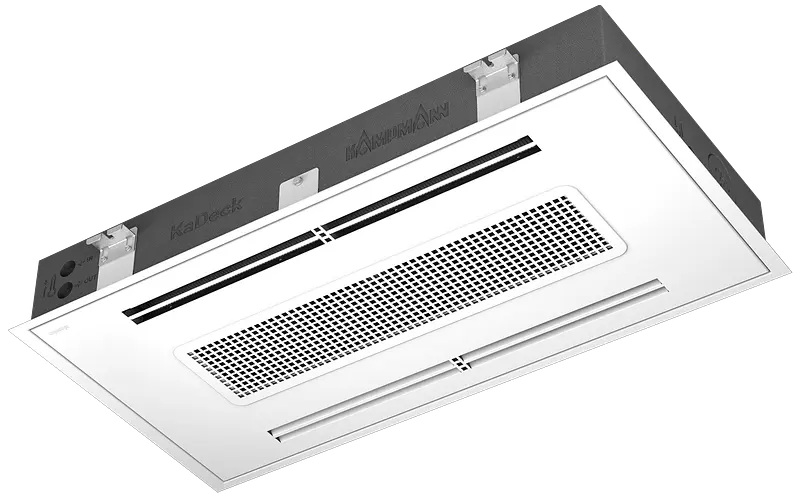
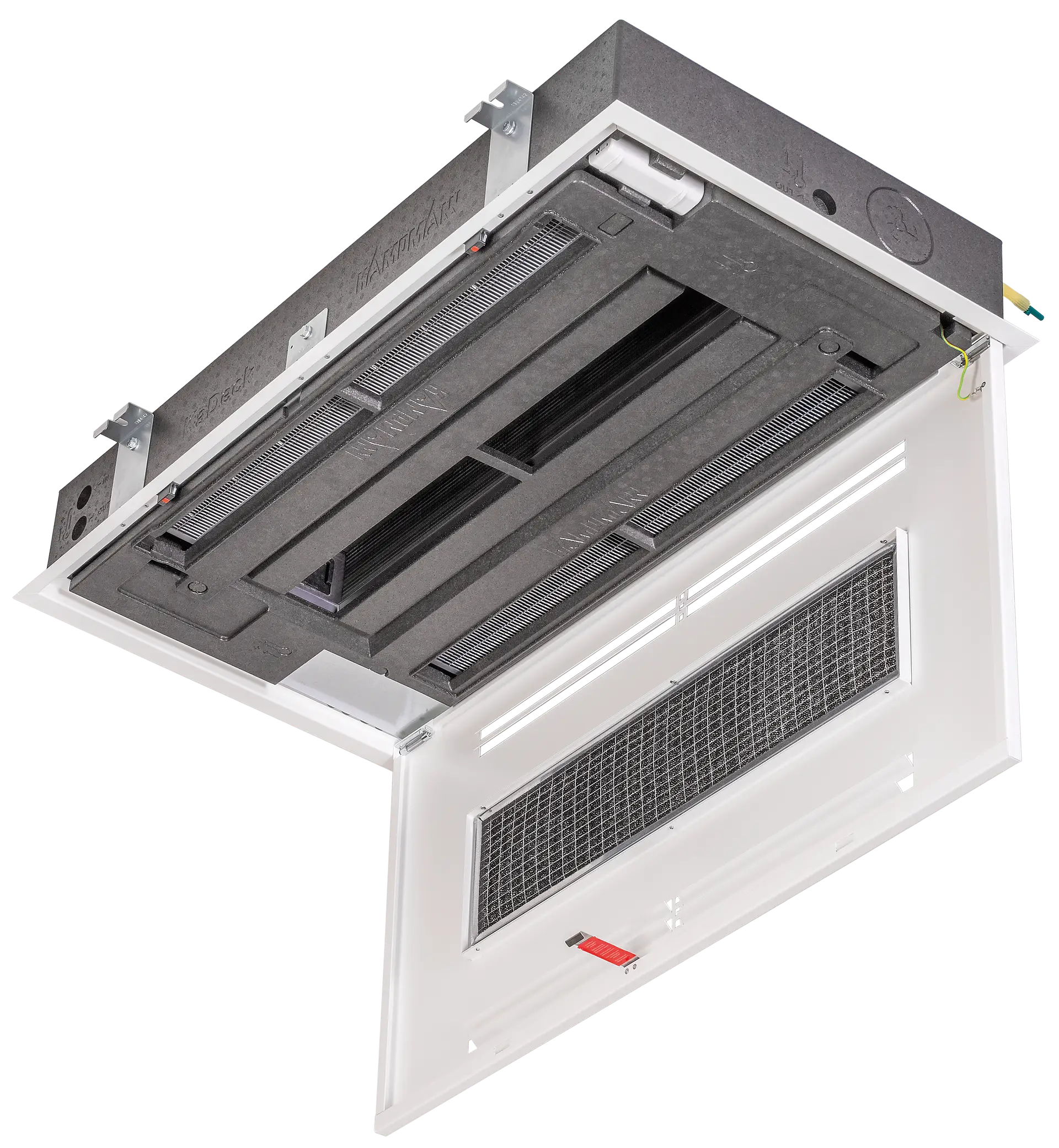
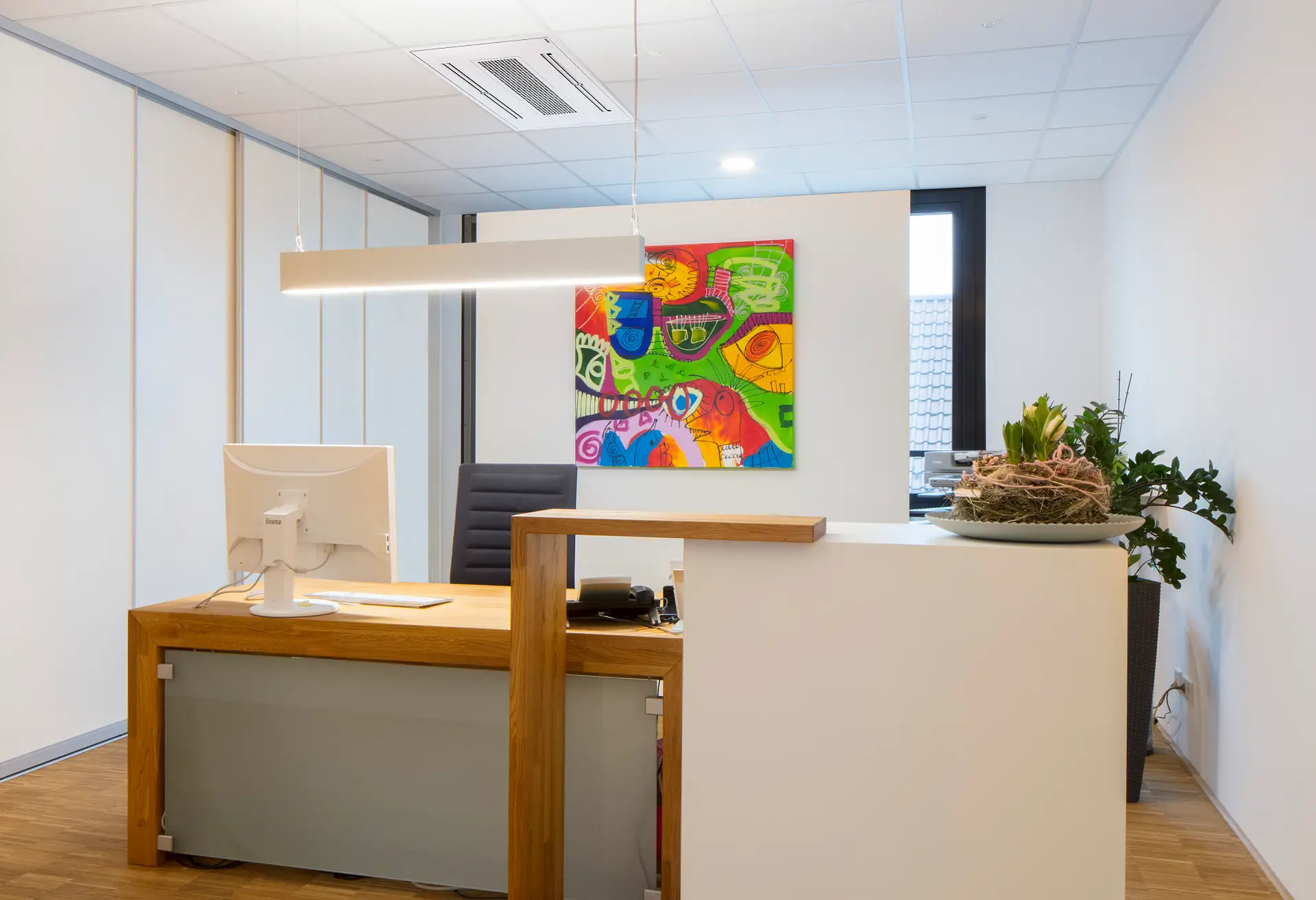
2-pipe system
With this design, the entire heat exchanger surface is available for temperature control, depending on the medium currently present in the pipe system (cold or hot water). Switch-over between heating and cooling takes place centrally via the building management system. This variant is particularly suitable for applications with seasonal switch-over and reduced installation effort.
4-pipe system
This version is suitable for sophisticated air conditioning concepts in which each room zone or unit can be switched over individually between heating and cooling. By routing the heating and cooling medium separately, the system offers maximum flexibility and comfort - ideal for buildings with changing usage requirements.
| Type of system |
|---|
| 2-pipe |
| 4-pipe |
Both versions are based on the same high-quality basic design and differ only in the equipment for condensate treatment.
Variant for dry cooling: for operation above the dew point. It does not contain a condensate tray or pump and must not be operated with flow temperatures that cause the temperature to fall below the dew point.
Variant for humid cooling: for operation with cooling media below the dew point. It has an integrated condensate tray and a condensate pump to reliably collect and remove any condensate.
| Unit design |
|---|
| dry cooling |
| wet cooling |
Two variants enable optimum integration into different ceiling systems. For installation in suspended grid ceilings, we offer:
The selection of the appropriate unit design depends largely on the existing ceiling system. The device drawings provide information on the number of grid fields required.
| Ceiling version |
|---|
| 600 x 600 mm |
| 625 x 625 mm |
The single-sided version is particularly suitable for installation along room edges or in peripheral areas. It offers a compact solution for smaller zones or asymmetrical room layouts.
The two-sided version is designed for central ceiling-mounted installation and has two tangential fans. This achieves a higher air output, which has a positive effect on the cooling and heat output. This variant is particularly suitable for larger rooms or uniform air distribution.
When making the selection, particular attention should be paid to areas where people are present and the air flow in the room.
| Air outlet |
|---|
| one-sided air outlet |
| two-sided air outlet |
We offer various solutions for the control and regulation of our units, which can be used depending on the application and requirements:
Electromechanical control
This variant is ideal for simple applications. All integrated actuators are factory-wired to terminals and can be connected to our electromechanical accessories such as thermostats or external controllers.
KaControl MC1
Our comprehensive comfort control offers extended control options for individual rooms or appliance groups. It can be operated either via a touch display or a web interface. Thanks to on-site 0-10 V control or common communication protocols such as Modbus RTU & TCP, BACnet and KNX, this solution is ideal for all BMS applications.
| Control option |
|---|
| electromechanical 230 V |
| KaControl MC1 |
Avoid the following:
Example: KaDeck with two-sided air outlet
at 7/12/27°C 48%rh:
Coanda effect:
Mounting the units:
When operating the unit below the dew point, note the following:
Serves as proof for certification systems, e.g:
Results per page
Results per page
Page 1 of 0
Results per page
Results per page
Page 1 of 0