Katherm HK P
EC tangential fan-assisted convection for heating or cooling with primary air.
- Heating
- Cooling
- Ventilation
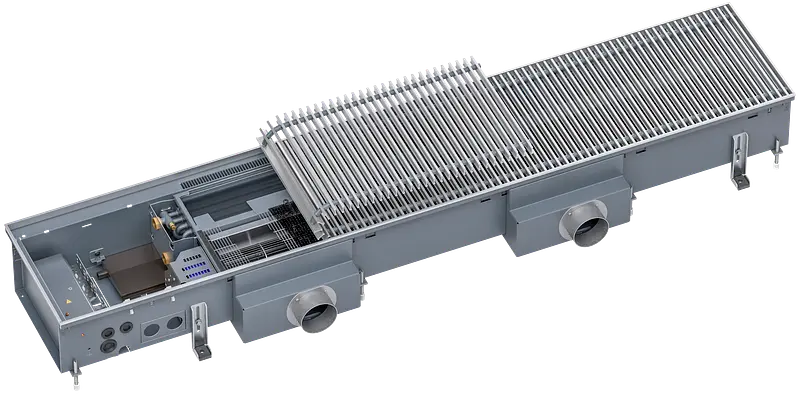
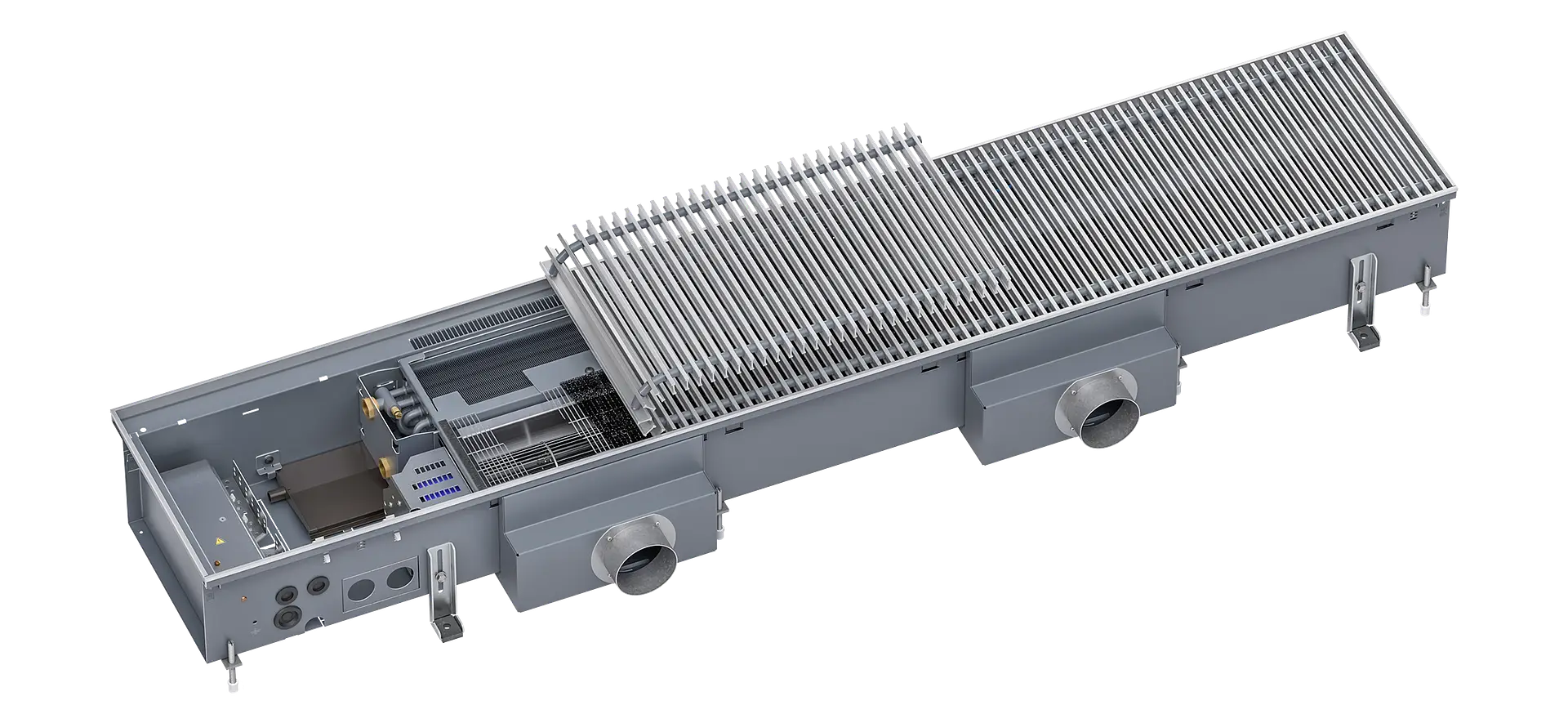
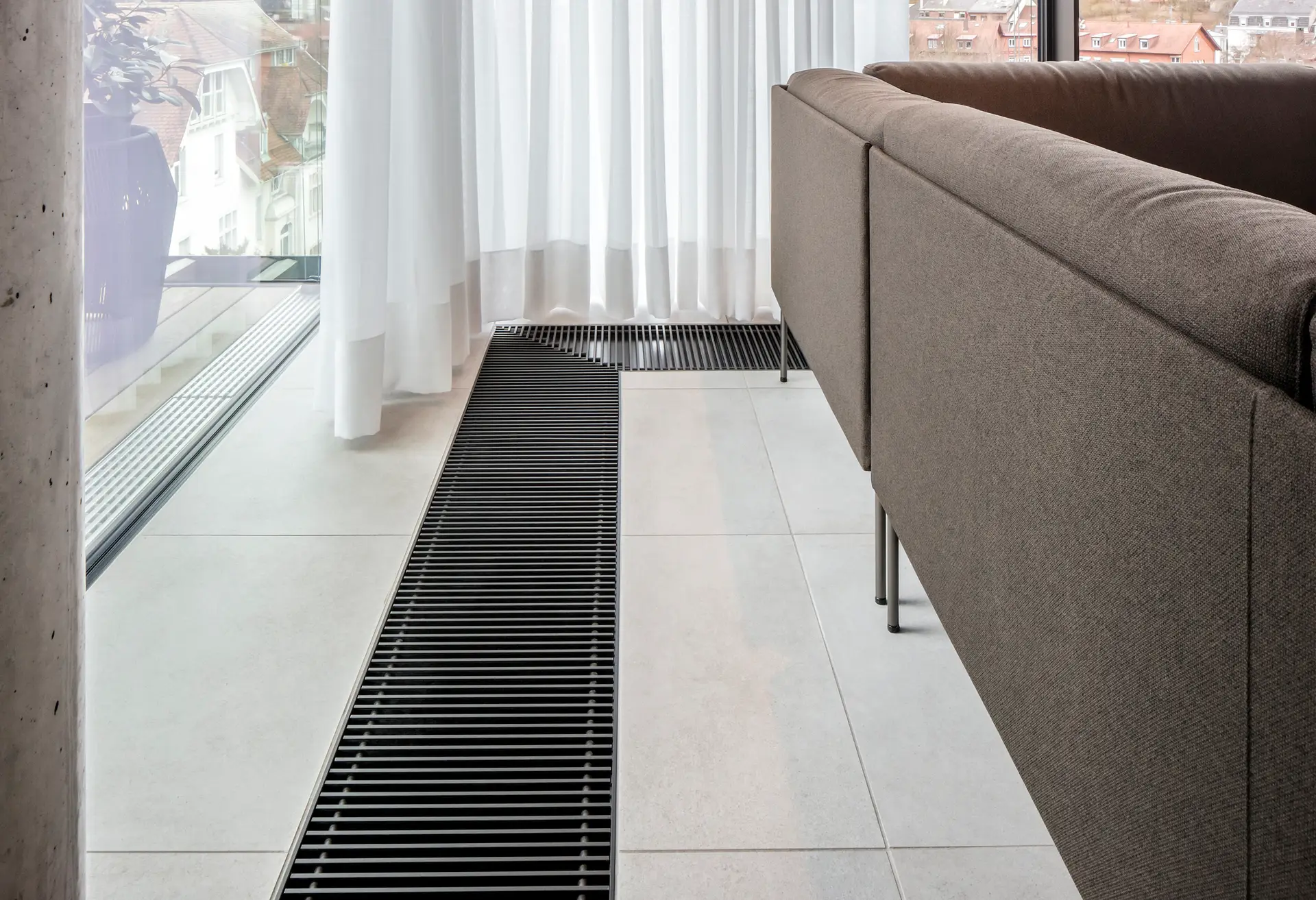
Trench convectors can be selected in different lengths (A) depending on the version, so that they can be optimally integrated into common window hinge systems.
The functional width (B) and height (C) allow individual adaptation to the floor structure and at the same time determine the performance of the trench convectors.
Continuous hinges can be realized using empty parts, column recesses, angles, etc.
| Width (B) | Height (C) | Length (A) |
|---|---|---|
| 310 mm | 180 mm | 830 - 2990 mm |
2-pipe system
With this design, the entire heat exchanger surface is available for temperature control, depending on the medium currently present in the pipe system (cold or hot water). Switch-over between heating and cooling takes place centrally via the building management system. This variant is particularly suitable for applications with seasonal switch-over and reduced installation effort.
4-pipe system
This version is suitable for sophisticated air conditioning concepts in which each room zone or unit can be switched over individually between heating and cooling. By routing the heating and cooling medium separately, the system offers maximum flexibility and comfort - ideal for buildings with changing usage requirements.
| Type of system |
|---|
| 2-pipe |
| 4-pipe |
Various grating variants are available for the cover, which ideally meet both functional and design requirements. Different materials can be selected depending on the application area.
In addition, different surface coatings and colors are possible in order to achieve a visual adaptation to the building architecture and interior design.
What is technically relevant is that the choice of material and geometry can influence the free air cross-section and thus have an impact on the performance of the unit. These effects are taken into account in the performance calculation.
| Grille design | Grille finish | Grille bar spacing | Free area, approx. |
|---|---|---|---|
| Roll-up grille | Aluminium, natural anodised | 12.0 mm | 70 % |
| Roll-up grille | Stainless steel | 10.5 mm | 65 % |
We offer various solutions for the control and regulation of our units, which can be used depending on the application and requirements:
Electromechanical control
This variant is ideal for simple applications. All integrated actuators are factory-wired to terminals and can be connected to our electromechanical accessories such as thermostats or external controllers.
KaControl MC1
Our comprehensive comfort control offers extended control options for individual rooms or appliance groups. It can be operated either via a touch display or a web interface. Thanks to on-site 0-10 V control or common communication protocols such as Modbus RTU & TCP, BACnet and KNX, this solution is ideal for all BMS applications.
| Control option |
|---|
| electromechanical 230 V |
| KaControl MC1 |
The units are equipped with quiet, sound-optimized EC fans.
Sound pressure and sound power levels are tabulated in the technical data.
The actual sound pressure level depends heavily on:
Recommendation: The design should always take into account the permissible sound pressure level in the room.
Supply modules positioned below the Katherm HK unit are perfectly suited to supply prepared primary air (fresh air) into a space. It escapes through a discharge slot arranged along the length of the trench convector and mixes with the secondary air heated or cooled by the convector before exiting into the room.
Properties:
Features:
For simplified hydraulic connection of the Katherm HK, various valve kits are available for 2- and 4-pipe connections:
consisting of thermostatic valve, return shut-off valve and flexible stainless steel corrugated pipes with pressable copper fitting
The Katherm HK P meets, for example, the following requirements:
Serves as proof for certification systems, e.g:
Results per page
Results per page
Page 1 of 0
Results per page
Results per page
Page 1 of 0